★★★★★ To Kill A Mockingbird: All Rise! For A Standing Ovation

Harper Lee’s To Kill a Mockingbird is quintessential reading for both British and American students growing up. It appears on many GCSE and middle-school required reading lists, assigned over the summer and ready to be discussed with English teachers in the autumn. I first read Lee’s famous novel in seventh grade (age 12), and it has stayed with me ever since, becoming one of my favourite books of all time.
As an American living in the UK, it was particularly poignant to see Aaron Sorkin’s adaptation of this beloved story come to life on stage at the Lyceum. With everything going on in the world today, it feels especially (sadly) relevant, making this production feel not only timely, but necessary.
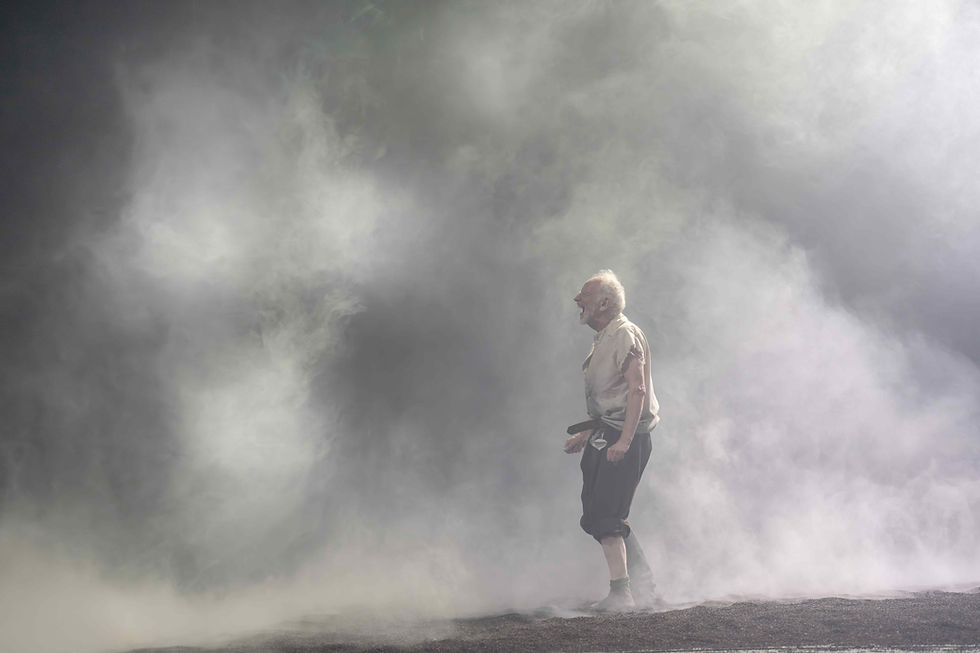
The stage production itself is truly a sight to behold. Elegant lamps drop down and retreat each time the story returns to the Maycomb courtroom, while disjointed windows and doors swirl around the stage, creating an unsettling mood as the children spy on their neighbour, Boo Radley.
The set design in particular immediately transports you to 1930s Alabama, where the story takes place. A large Southern wooden porch set serves as the hub where Atticus Finch (Richard Coyle) convenes with neighbours such as Judge Taylor (Stephen Boxer) and Bob Ewell (Oscar Pearce). It represents both a place of safety for his children—Scout (Anna Munden) and Jem (Gabriel Scott), and a meeting place when their new neighbour Dill (Dylan Malyn) arrives.
Atticus’ friendship with his housemaid Calpurnia, or “Cal” (stunningly portrayed by Andrea Davy), is especially compelling in Sorkin’s adaptation. Cal is given more authority and a compelling voice compared to her role in Harper Lee’s novel, which adds even more depth and emotional weight to the production.
Scout (brilliantly performed by Anna Munden) is a precocious child who idolizes her father and everything he represents. Atticus is a lawyer defending Tom Robinson (Aaron Shosanya), a Black man unjustly accused of a crime against a white woman in Maycomb. Shosanya’s performance is quiet, raw, and deeply memorable. It is a truly beautiful portrayal that lingers long after the curtain comes down.
Without giving spoilers, this is a story best experienced live or discovered for the first time as a reader. Sorkin’s adaptation places Scout firmly at the centre by having her break the fourth wall. She speaks directly to the audience, guiding us through what’s coming next, how events unfolded, and why they mattered. As the narrator in the novel, we appreciated how Sorkin reimagines her as a companion to the audience. The story feels even more raw because you are right there with her, as though you are the jury witnessing the trial of Tom Robinson and its impact on every character.
Every performance is nuanced and powerful and as an audience member, you are completely invested. Coyle’s Atticus is stoic yet warm, taking on a life of its own when compared to Gregory Peck’s iconic portrayal in the film adaptation. The entire ensemble is remarkable, and it was an absolute treat to watch one of my favourite American novels brought to life on stage in the UK.
This production moved me to tears while still leaving me with hope. On opening night, the cast received a standing ovation—and it was well deserved. Stunning from beginning to end, Aaron Sorkin’s adaptation of Harper Lee’s To Kill a Mockingbird is an unforgettable, deeply moving piece of theatre that I highly recommend.
To Kill a Mockingbird is at the Lyceum until 7th February with limited tickets available from the Sheffield Theatres website here.